Table of contents
The safari is changing, and not only because sightings are harder to predict in a warmer, drier bush. Across Southern Africa, lodges, guides, and conservation groups are quietly reshaping the classic “Big Five” itinerary, adding activities that mix science, culture, and adrenaline, and turning downtime between game drives into the most memorable part of the trip. This shift is also pragmatic: longer stays, diversified experiences, and year-round travel patterns are helping destinations cushion seasonal swings, while giving visitors a more layered sense of place.
Tracking at night, when the bush switches gears
The day-drive safari has long dominated the brochure, yet the bush’s real turnover happens after sunset, when temperatures drop, herbivores re-emerge, and predators recalibrate their hunting routes. Night drives, where permitted, are no longer sold as a gimmick, they are increasingly framed as a structured extension of natural history, built around spotlight etiquette, species-specific behaviour, and the realities of what you can and cannot responsibly view. Guides tend to prioritise animals that are genuinely more detectable after dark, such as bushbabies, genets, civets, aardvark, porcupine, and serval, while also explaining why certain high-profile species should not be pressured into a “perfect” sighting.
Done well, the activity changes how travellers understand ecology: daytime sightings can feel like a highlight reel, whereas night movement reveals the mechanics of survival, from how termites swarm to how owls hunt without announcing themselves. Several reserves in South Africa and neighbouring countries have expanded specialist guiding for these drives, investing in training on nocturnal identification, animal stress signals, and the use of red filters that reduce disturbance compared with harsh white beams. The economics matter too, because night drives distribute guest demand across more hours, easing pressure on peak morning routes, and helping lodges justify employing guides year-round rather than only in high season.
There is also a safety and governance angle that travellers increasingly ask about, especially as wildlife tourism becomes more scrutinised. Many private reserves operate under strict rules on off-roading, minimum viewing distances, and limits on the number of vehicles at a sighting, and reputable operations will brief guests clearly before departure. The best question to ask at booking is not “Will we see leopards?”, it is “What is your protocol when you do?”, because that answer signals whether the experience is built around animal welfare or social-media urgency.
On foot, the small stuff becomes huge
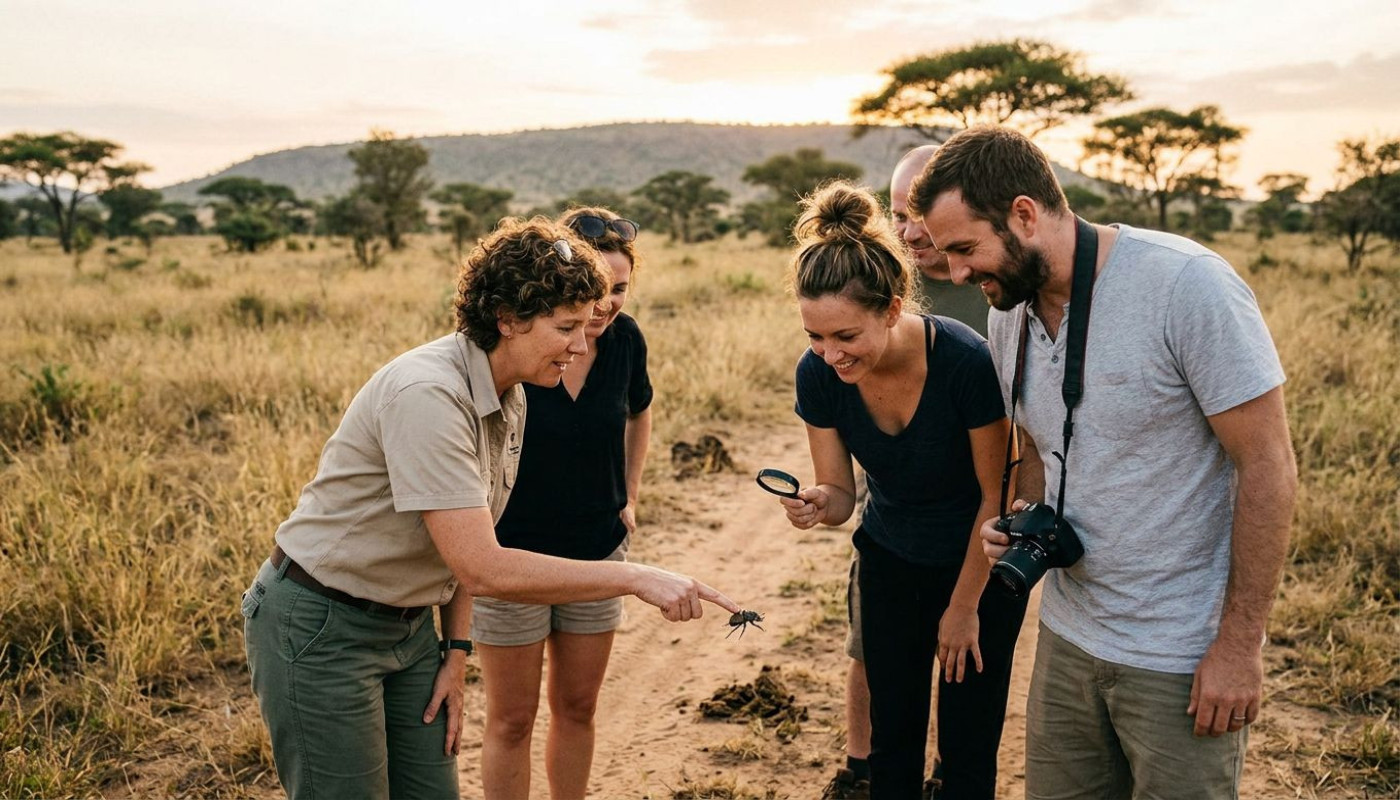
It is hard to overstate how walking safaris recalibrate attention. In a vehicle, the landscape moves past you like a cinema screen, yet on foot, you move at the pace of tracks, wind shifts, and the sudden hush that signals something nearby. The shift is not just psychological, it is biological: your guide reads dung moisture, crushed grass, and alarm calls in real time, and what sounded like empty space becomes a map of recent decisions made by animals you may never even see. For many guests, that “invisible safari” becomes the most intellectually satisfying part of the trip, because it explains what game drives often skip: how the bush actually functions between headline sightings.
Walking is also where the “unexpected” tends to happen, particularly with insects, plants, and birds that rarely make the main itinerary. A guide might stop you over a modest-looking mound and unpack the role of termites in soil aeration, carbon cycling, and seed dispersal, or show you how certain acacias negotiate survival with thorns, tannins, and symbiotic ants. Birding, often underestimated by first-time safari-goers, thrives on foot too, because you can stand quietly through a chorus and learn the difference between an alarm call and a territorial display. In South Africa alone, the bird list exceeds 850 species, and even a short stay can produce dozens of lifers for visitors who slow down and listen.
Because walking safaris are regulated, they tend to be offered in controlled formats: small groups, armed and highly trained guides, and clear rules about spacing and silence. That structure is part of the appeal, because it replaces the “thrill” narrative with something closer to fieldwork. The demand has grown alongside travellers’ appetite for meaning, and it dovetails with conservation messaging that is measurable rather than vague, such as explaining how anti-poaching units use tracking skills, how corridors reduce human-wildlife conflict, or why certain species rebound only when grazing pressure is managed. If you are planning a trip and want options that go beyond the checklist mentality, it is worth look at this now, because the most rewarding itineraries tend to be those that balance classic drives with at least one immersive, low-speed experience.
From capture to dataset: joining real conservation work
The most significant evolution in safari programming may be the move toward participatory conservation experiences, not as feel-good theatre, but as a window into how modern wildlife management is actually done. In many landscapes, especially fenced private reserves and fragmented ecosystems, “hands-off” is not a realistic policy, managers make decisions about water points, fire regimes, population density, and translocations, and those decisions increasingly rely on data. Visitors are now being invited, under strict supervision, to observe or assist in parts of that process, from rhino notching operations to elephant collaring and the retrieval of camera-trap cards that feed long-term monitoring.
There is an important distinction here: ethical programmes do not sell physical contact with wild animals, and they do not promise dramatic interventions on demand. Instead, they explain the protocols, the veterinary safeguards, and the reason the data matters. GPS collars, for example, can help track ranging patterns, identify high-risk poaching zones, and quantify how animals use corridors during drought, and camera traps, placed systematically, create datasets that are now central to population estimates for elusive species like leopard. In parts of Southern Africa, research groups increasingly combine these tools with acoustic monitoring and satellite imagery, building multi-layered pictures of ecosystem health that can be compared season to season.
For travellers, the appeal is not only access, it is clarity. When you see how a dehorning operation is debated, costed, and implemented, you understand the trade-offs rather than the slogans, and when a ranger points to a map of incursions and explains patrol strategy, the conservation story becomes grounded in logistics, staffing, and budget lines. Those budgets are not abstract: anti-poaching work can cost thousands of dollars per square kilometre annually in high-risk areas, depending on terrain and threat level, and private reserves often fund a portion through tourism revenues. The strongest experiences are those that are honest about uncertainty, because the bush is not a laboratory, rains fail, fences break, communities need jobs, and animals do what they do.
Community, cuisine, and craft: the safari beyond the gate
The safari has sometimes been sold as an escape from people, yet the future of wildlife tourism depends on them. Across the region, more operators are building experiences that connect visitors to the communities living alongside protected areas, in ways that are richer than a staged dance performance and more relevant than a souvenir stop. This can mean guided visits to community projects, meetings with local entrepreneurs, or storytelling sessions that explain how land-use decisions shape the boundaries of conservation. The result is not only more meaningful for guests, it can also help redistribute tourism income in places where the costs of living with wildlife, crop loss, livestock predation, and safety risks, are tangible.
Food has become one of the most effective entry points, because it carries history without requiring a lecture. Bush dinners and braais are evolving into curated culinary experiences, pairing local ingredients with an explanation of seasonality and supply chains, and increasingly featuring cooks who interpret heritage recipes rather than replicate a generic lodge menu. Craft, too, is shifting toward transparency, with some lodges facilitating visits to cooperatives and workshops where guests can see how beadwork, woodcarving, or textiles are made, and understand what fair pricing actually looks like. For travellers wary of “voluntourism,” these encounters can be a better alternative, because they centre commerce and agency rather than performative helping.
There is also a practical reason these off-drive activities are gaining popularity: climate variability can disrupt the classic schedule. When heat spikes, animals may stay in shade longer, and midday can become less productive for sightings; structured cultural and culinary programming fills that gap without forcing vehicles to chase an increasingly elusive spectacle. The safari, in other words, becomes resilient, offering a fuller day even when nature refuses to perform on cue, and giving travellers a story that is not dependent on a single iconic photo.
Planning notes: build variety into the budget
Book early for peak months, and ask what is included, because walking safaris, night drives, and research add-ons can have limited slots and specific age rules. Set a clear budget for park fees, guide gratuities, and transfers, and check whether any conservation levy is earmarked for projects you can verify. In South Africa, some domestic travellers may access seasonal specials; international visitors should watch shoulder-season rates.
On the same subject
Is The Road Less Traveled Worth It? Debating Lesser-known Destinations
Local Whispers: Off-the-beaten-path Travel Tips You Won’t Find In Guides

Lost On Purpose: Why Spontaneous Detours Lead To Memorable Travel Stories

From Sketch To Suitcase: The Art Of Designing Meaningful Travel Itineraries
The Unplanned Stopover: Why Every Journey Needs A Wild Card

Unexpected Benefits Of Planning Activities With Locals
How Hidden Gems Reshape Your Travel Itinerary Expectations
Exploring Hunter-Gatherer Cultures: Ethical Safaris And Tribal Insights

How To Plan The Perfect Sailing Itinerary